Hello! Minasan! Welcome to "Dictation for Every Day" (D4E: version 5) a.k.a. Mainichi no Kikitori
Workbook
PDF Workbook (volume 1, 2, and 3) is available from
[here]!
It includes the notes of words, phrases and grammars.
News and Story
2024.07.14: Volume 3, episode 101-150 starts.
An episode is updated every day.
A.E.A.D. (An Expression A Day)
If you want to learn Japanese expressions more,
visit the A.E.A.D. (An Expression A Day) page:
AEAD Search.
2026.10.27 Tue #930: Oh, I missed that.
あ、見落としてた。
A, miotoshiteta.
Oh, I missed that.
A「この欄、まだ空白だよ。」 B「あ、見落としてた。」
A: This field is still blank. B: Oh, I missed that.
"A, miotoshiteta" is an immediate reaction upon realizing that something that should have been noticed was previously overlooked. "A" marks the moment of realization, while "miotoshiteta" looks back on the speaker's earlier failure to notice it. What was overlooked need not be stated because it is understood from the preceding utterance or the immediate situation.
2026.10.26 Mon #929: You're starting that far back?
え、そこから?
E, soko kara?
You're starting that far back?
A「昨日、どうなったの?」 B「それがね、そもそも先週の月曜日に...」 A「え、そこから?」
A: So, what happened yesterday? B: Well, it all started last Monday... A: You're starting that far back?
"E, soko kara?" is an immediate reaction to someone beginning an explanation further back than expected. "Soko" refers not to a physical location but to the starting point of the explanation. The activity itself remains unstated because it is understood from the preceding utterance. The expression may convey surprise, mild protest, or humor.
2026.10.25 Sun #928: You're telling me this now?
え、今それ言う?
E, ima sore iu?
You're telling me this now?
A「これで準備完了!」 B「あ、会議室、変更になったって」 A「え、今それ言う?」
A: All set! B: Oh, apparently they've changed the meeting room. A: You're telling me this now?
"E, ima sore iu?" expresses surprise or frustration at the timing of someone's remark. "Ima" refers not simply to the present moment but to the speaker's judgment that the information has come too late in the ongoing situation. "Sore" points to what was just said. Although phrased as a question, the expression does not necessarily request an answer.
2026.10.24 Sat #927: Case closed.
一件落着。
Ikken rakuchaku.
Case closed.
A「あった! 鞄の底に入ってた」 B「ああ、一件落着。」
A: Found it! It was at the bottom of my bag. B: Ah, case closed.
"Ikken rakuchaku" acknowledges that a problem has been resolved and brings the interaction concerning it to a close. What the case refers to is understood from the shared situation. The expression has a somewhat formal tone, which can create a lightly humorous effect when used for a minor everyday problem.
2026.10.23 Fri #926: Already?
え、もう?
E, mou?
Already?
A「はい、できたよ」 B「え、もう?」 A「うん、簡単だったから」
A: All done! B: Already? A: Yeah, it was easy.
"E, mou?" is an immediate reaction to something happening sooner than expected. "E" expresses surprise, while "mou" indicates that the event has occurred earlier than anticipated. The event itself need not be stated because it is understood from the preceding utterance or shared situation.
Let's practice every day!
Let's learn Japanese through dictation practice!
PDF Workbook (volume 1 and 2) is available from
[here]!
It includes the notes of words, phrases and grammars.
This is the dictation practice site operated by Japanese Language Teaching Section, Tokyo Institute of Technology.
This practice involves a variety of natural expressions in daily conversation.
You can practice 10 sentences a day depending on your language ability.
It's a very simple exercise. You just follow the audio you hear and type in Roman letters.
Your comments and bug reports are very welcome. Please submit from here.
Zen and the Art of Dictation
Let's learn Japanese through drill and practice!
You will practice 10 sentences in an episode.
It's a very simple exercise.
You just follow the audio you hear and type in roman letters.
The first objective is to learn the basic Japanese sounds
and hiragana/katakana combinations.
You can practice as many times as possible.
The more you practice, the better you will get.
Please regularly contribute your time to this practice.
It is important to practice every day rather than to practice a lot at once.
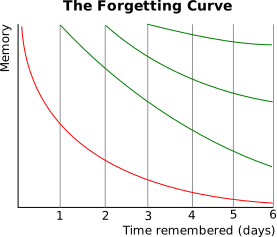
The following is the psychological evidence of the importance of regular practice:
Figure 1: The forgetting curve described by Hermann Ebbinghaus.
Here, b represents 'Savings' expressed as a percentage, and t represents time in minutes, counting from one minute before end of learning. The constants c and k are 1.25 and 1.84 respectively. Savings is defined as the relative amount of time saved on the second learning trial as a result of having had the first. A savings of 100% would indicate that all items were still known from the first trial. A 75% savings would mean that relearning missed items required 25% as long as the original learning session (to learn all items). 'Savings' is thus, analogous to retention rate.
 Drill for Every Day (D4E: V5)